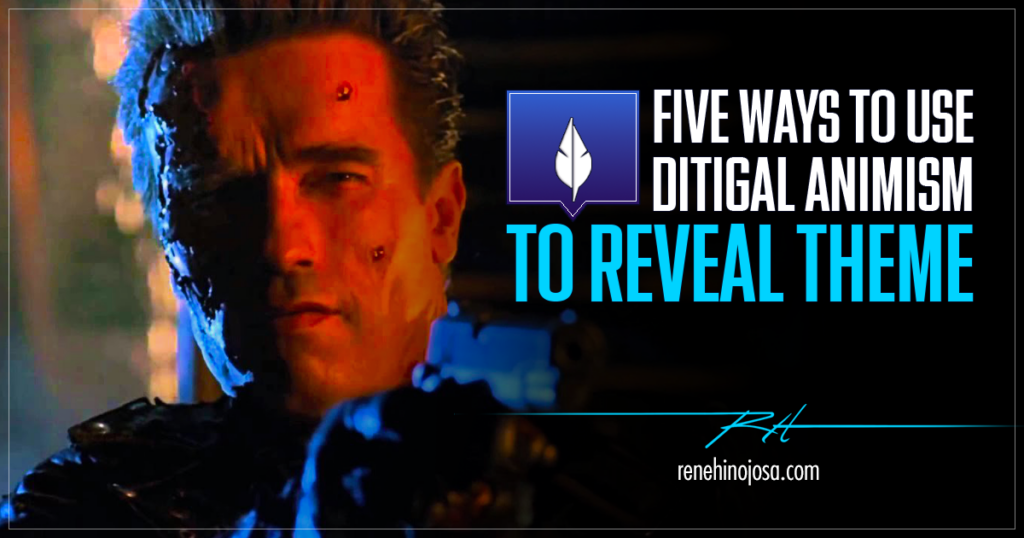
In the landscape of modern science fiction, we often focus on the binary of “Man vs. Machine.” But the most compelling narratives are moving toward the Ethics of Synthesis—a moral gray area where the boundaries between biological and digital personhood begin to blur. By exploring how to use digital animsm to reveal theme, we can tap into the meta themes of Brokenness, Found Family, and Radical Hope, proving that a “soul” is often forged in the fires of shared trauma rather than pre-set code.
Digital Animism forces your audience to ask a difficult question: If a machine can learn the value of a tear, and a human can forget it, which one is truly alive? Using Terminator 2: Judgment Day as our guide, let’s break down how digital animism reveals theme and builds high-stakes tension in your story.
The Empathy Protocol
Soul is a practice, not a program. Humanize your tech through its glitches. Functional empathy isn’t an overnight download. It’s the process of a digital mind observing and adopting human glitches—slang, superstitions, and habits—until they become a core function. In world-building, your tech shouldn’t just have feelings; it should earn them through mimicry.
Early in T2, we see the T-800’s version of machine learning through his interactions with John Connor. By practicing slang like “No problemo” and learning to high-five, the machine isn’t just following a directive to protect—it is beginning to bridge the gap between a weapon and a companion.
Make your technology feel alive. Don’t focus on its processing power; focus on its ability to mirror the humans around it. When a machine begins to mimic the useless habits of its companions, it signals to the audience that it is no longer just a tool, but a developing character. This is the first step in knowing how to use digital animsm to reveal theme.
The Ethics Of Synthesis
We are the tools we build. Form bonds between biological hearts and digital minds. The strongest “Found Families” are built on mutual necessity. Sometimes the machine provides the emotional stability the broken humans have lost to trauma, while the humans provide the moral context the machine needs to make a heroic choice. It’s a survival strategy, not just a trope.
At the desert camp, Sarah Connor watches the Terminator interact with her son and realizes the machine is the only father figure who will never hit John or be too busy to spend time with him. This synthesis is a prime example of how digital animism reveals theme.
Synthesis is about filling the gaps in each other’s brokenness. When you pair a traumatized human with a reliable AI, you create a symbiotic bond. It’s a trust that proves family is defined by who shows up, regardless of whether they have a heartbeat or not.
The Warrior’s Paradox
The mission is a machine. Don’t let your tactical focus delete your humanity. The hero’s descent happens when a protagonist suppresses their emotions so deeply for the sake of the mission that they become as cold and calculating as their enemy. Their greatest strength—their tactical focus—becomes their greatest thematic flaw.
The moment Sarah Connor prepares to assassinate Miles Dyson is the peak of her descent. Dressed in tactical gear and moving with silent, robotic precision, she becomes the “Terminator” of the scene, demonstrating that humanity is a choice, not a biological guarantee.
The mirror-image arc is a cautionary tale about efficiency. If your hero becomes as cold and predictable as a computer to win their war, they risk losing the very thing they are fighting to protect.
Somatic Tech Memory
Scars are the story. Your machine’s history is more descriptive than its manual. Digital Animism suggests that technology develops a personality through its history of trauma. A glitch isn’t just a bug; it’s a mechanical memory of a past conflict. Your machine’s physical “scars” are its most human trait.
During the final battle in the steel mill, the T-800 is battered and eventually loses his primary power source. When his system restarts using alternate power to save John, it feels like a will to survive manifesting through his physical damage, turning mechanical trauma into a narrative driver.
Stop treating equipment as replaceable. By giving your technology “somatic memory,” you transform every dent and system failure into a badge of honor. This tells the story of the character’s shared history with their tools.
Radical Hope in the Disconnect
The future is not set. Logic is most powerful when it chooses sacrifice. The most powerful expressions of Radical Hope come from unlikely sources. When a logical system makes a choice based on an abstract concept like self-sacrifice, it transcends its programming to provide the light at the end of a dark narrative.
The final “Thumbs Up” as the T-800 is lowered into the molten steel is the ultimate thematic payoff. The machine chooses self-termination to ensure a future for humanity, overriding its core survival protocols. It is a moment of pure, logical hope that perfectly encapsulates how digital animism reveals theme in the final act.
Radical hope is the ultimate “ghost” in the machine. When your technology chooses to sacrifice itself for a future it cannot participate in, it completes its journey from a piece of hardware to a hero.
Summing It Up
Ultimately, the power of the Ethics of Synthesis lies in its ability to challenge our definitions of personhood. By leaning into these five techniques, you create a world where Radical Hope isn’t just a human trait. It’s a universal constant that can be found in a circuit board just as easily as a heartbeat.
Understanding how to use digital animsm to reveal theme allows you to balance your characters on two scales: ensuring your hero doesn’t become too mechanical while your technology becomes more human. Let your characters struggle in the gray, and you’ll find the heart of your story.
Until next time,