Your setting is more than a backdrop for your characters to inhabit. It is a force your characters must negotiate with in order to survive. When the environment itself fights back, every mile gained feels like a victory and every mechanical failure feels like a death sentence.
By transforming your map into an antagonist, you create organic stakes that don’t rely on a villain’s presence. This week, we explore how to use physical laws and hostile thresholds to push your protagonists to their absolute limits.
Cartography Of Conflict
Map your limits. Break your walls. The environment is your story’s constant threat. Hostile terrain creates natural obstacles like rising tides or sandstorms that force characters into impossible choices. When the world itself is the enemy, every mile gained is a hard-won victory. Don’t just give your characters a destination. Give them a barrier that requires a specific price to cross. Whether it’s a radiation belt in space or a mountain pass, the environment should force a choice: what are you willing to leave behind to move forward?
In the film Dune, Paul and Jessica are forced into the open desert of Arrakis. This isn’t just a walk. It’s a puzzle where the rhythmic vibration of normal footsteps attracts giant sandworms, forcing them to adopt a “sandwalk” to survive.
This scene turns the map into a puzzle, where the terrain dictates exactly how the characters must move and breathe just to exist within it. It forces the characters to adapt their behavior to the environment, raising the tension with every step.
Price Of The Path
Movement costs. Travel burns. Movement should never be free. Force characters to trade safety for speed by placing vital resources in the most dangerous locations. Making the journey difficult ensures the destination feels earned rather than inevitable. Use the weather of your world to dictate the tension. A looming storm or a depleting oxygen supply creates a natural ticking clock that doesn’t feel forced by the plot, grounding the stakes in the physical reality of the world you’ve built.
In Cliffhanger, the environment provides the ultimate ticking clock. High-altitude peaks and sheer ice faces mean that every second spent hanging or climbing is a second where strength fails and gear reaches its breaking point.
The film illustrates how the path itself consumes the characters’ resources, making every inch of progress a desperate trade-off. The environment provides a constant, impartial pressure that keeps the audience on edge regardless of the human conflict.
Sensory Survival
Feel the grit. Fear the cold. Use physical discomfort to ground the reader in the struggle. Small details like the smell of ozone or the sting of salt air make the setting a living obstacle. Sensory anchors turn a simple walk into a fight for survival.Focus on the small, gritty details that make a setting feel real and dangerous. Descriptions of grit in the teeth or the bone-deep cold turn the environment into a living, breathing obstacle that the character must constantly negotiate with.
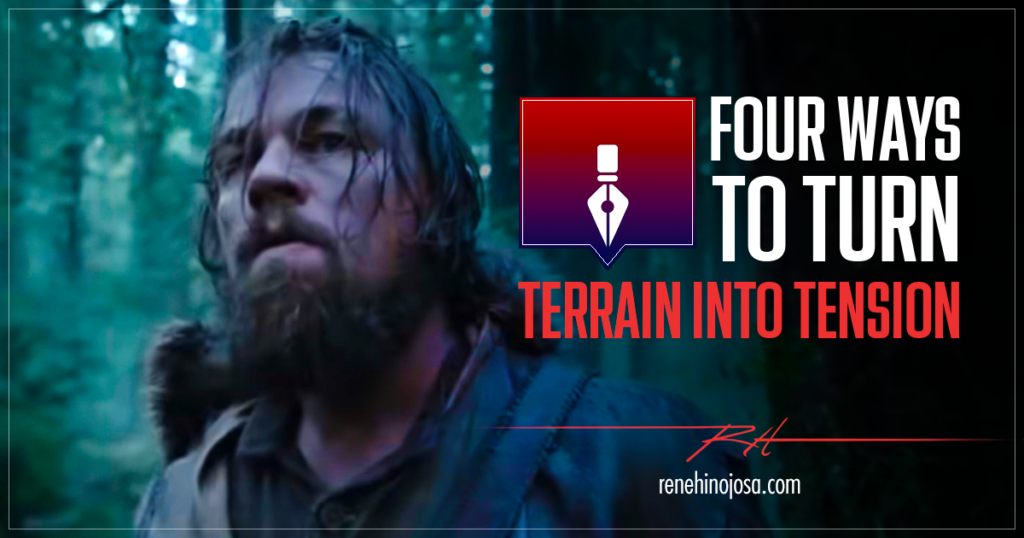
In The Revenant, the protagonist is forced to navigate the brutal cold and visceral danger of the wild. The sensory experience of the environment—from the rushing water to the frozen earth—becomes the character’s primary conversation.
These sensory anchors ground the struggle, making the environment a living obstacle. By emphasizing physical discomfort and the raw power of nature, the story creates an immersive experience that makes survival feel like a hard-won victory.
Tool-Based Ingenuity
Drop the sword. Use the world. Stripping a character of their gear forces them to interact with the environment creatively. Show them repurposing scrap or using terrain for cover to defeat an enemy. This reveals intelligence while making the world a functional part of the action. Stripping a character of their standard gear forces them to interact with their environment in creative ways. Showing a character repurposing scrap or using terrain for cover reveals intelligence and makes the world a functional part of the story’s mechanics.
In Apollo 13, the crew must build a carbon dioxide scrubber using only the random parts available on the ship. They must find a way to fit a square cartridge into a round hole to keep the air breathable.
By repurposing their limited environment, the characters demonstrate intelligence and ingenuity. It transforms a technical failure into a moment of character triumph, proving the setting itself provides the tools for survival.
Summing It Up
Whether you are writing a space opera or a gritty survivalist tale, remember that your world should never be passive. Force your characters to fight for every mile, and your readers will feel the weight of their journey.
Look at your current draft and find a place where the sun is too bright, the air is too thin, or the ground is too steep. Make the world earn its place in your story.
Until next time,