In the vastness of a science fiction universe, it is rarely the star charts or the political treaties that make a world feel real. Instead, the true weight of a setting is found in the objects your characters carry, break, and trade. When you learn how to use objects to build your world, you move away from treating technology as a simple plot device and begin treating it as a narrative engine. This is the core of Object-Oriented World Building, where every tool is a storyteller and every artifact carries the DNA of the culture that created it.
To master how to use objects to build your world, we will break down four tactical pillars: Visible History, Biological Integration, Scarcity Economics, and Structural Fragility. From the scarred lightsabers of Star Wars to the AI of Blade Runner 2049, we’ll explore how to transform your story’s inventory into a living, breathing history.
The Scarred Tool
History isn’t just written in books. It’s written in the scratches of the world. In lore-driven narratives, history is visible in the physical wear of the objects your characters touch. A “scarred” tool proves the world existed long before the story began, grounding your sci-fi and fantasy in a tangible, lived-in reality.
In Star Wars: A New Hope, Ben Kenobi doesn’t just describe the Jedi; he hands Luke his father’s lightsaber. The hilt is scuffed and distinctly weathered, suggesting decades of use in a conflict the audience hasn’t even seen yet. The object itself acts as a bridge between the “old world” and the current journey.
Visible history creates instant credibility by transforming inanimate objects into silent narrators. By summarizing a character’s past through the “scars” on their gear, you eliminate the need for long-winded exposition. This technique ensures your world feels persistent and storied, allowing the reader to infer a lifetime of experience through a single dented surface.
Biological Grit
Stop building tools. Start building a second skin. “Biological Grit” moves tech from being a passive accessory to an intimate extension of the character’s body. When survival depends on the “health” of a suit or ship, every mechanical failure becomes a direct biological threat.
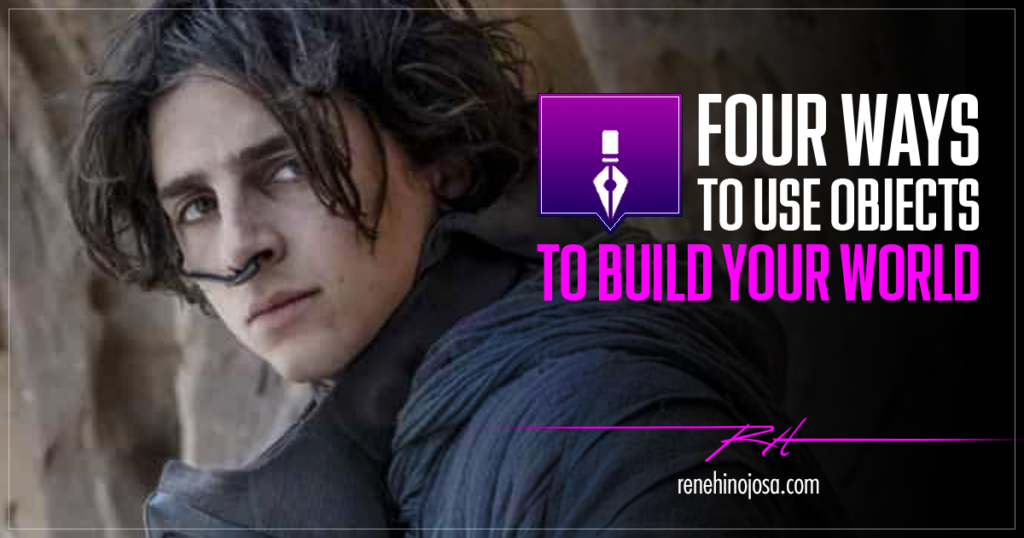
In Dune, the Stillsuit is the ultimate example of biological integration. The scenes in which characters meticulously seal their suits and adjust their nasal plugs demonstrate that the tech is a literal life-support system. It isn’t just a costume; it’s a machine that processes human waste into survival, making the desert environment feel perpetually lethal.
This approach raises the stakes by tethering mechanical function to physical survival. By summarizing the relationship between man and machine as a symbiotic struggle, you turn “maintenance” into high-tension plot points. The benefit is a deeper level of immersion where the environment feels tangibly dangerous and the technology feels vital rather than ornamental.
Scarcity Currency
Credits are useless in a crisis. Trade what you can’t afford to lose. “Scarcity Currency” is the ultimate shortcut to showing the state of your society. Shifting the economy toward survival essentials—like clean water or encrypted data—immediately signals the “brokenness” of the system.
In Children of Men, the world has descended into chaos, and traditional money has lost its luster. Instead, we see Jasper trading high-grade, “real” marijuana for favors and information. In a decaying world, sensory luxuries and tangible goods become the only currency with actual leverage.
Non-monetary trade functions as a socioeconomic summary of your world’s collapse. It tells the reader exactly what is rare and what is desperate, providing a clear window into the “Brokenness” of the world without a single political info-dump. The benefit is an immediate understanding of your world’s power dynamics based solely on what people are willing to barter.
Tactical Failure
Perfect tech kills tension. A well-timed glitch drives the plot. “Tactical Failure” highlights the limits of your world’s infrastructure. By showing technology prone to “planned obsolescence,” you remind the reader that characters are fighting the environment as much as any antagonist.
In Blade Runner 2049, the holographic companion Joi represents the peak of AI tech, yet she is still prone to the environment. When her emitter glitches and flickers during a heavy rainstorm, it reminds the audience that even “perfect” beauty in this world is fragile, digital, and subject to the decaying city around it.
Failure creates organic conflict by summarizing the fragility of your world’s progress. By building flaws into your technology, you force your characters to rely on their own sovereignty and ingenuity to solve problems. This ensures your protagonists drive the plot through their choices rather than being saved by their gadgets, making their victories feel earned.
Summing It Up
Ultimately, the most resonant worlds are those that feel lived-in, flawed, and tangibly connected to the characters who inhabit them. By mastering how to use objects to build your world, you move past the “set dressing” phase of writing and begin constructing a reality with actual depth.
As you look at your own “Narrative Engine,” ask yourself if your characters are carrying pristine tools or storied artifacts. Remember that in the realm of speculative fiction, a jammed blaster or a bartered luxury often says more about your society than a thousand words of history. When the objects are real, the world becomes undeniable.
Until next time,