World-building often traps speculative fiction writers. We spend hundreds of hours sketching planetary syndicates, calibrating plasma propulsion, and charting generational lore. But we stumble into the classic infodump snare when we finally write. We rely on experts, text crawls, or clinical dialogue. These techniques flatten tension and turn opening chapters into tedious lectures.
The best way to reveal an extraordinary world is to filter it through an unqualified mind. Character displacement—dropping an outsider into an unfamiliar ecosystem—forces narrative momentum. When your protagonist does not understand the local customs or laws, every setting detail becomes an obstacle. Your reader learns the rules naturally, earning the lore through the struggles your character faces while they adapt.
Sensory Overload
When an outsider enters an unfamiliar reality, their brain lacks context for the background noise. Do not let your protagonist neatly catalog their surroundings. Flood their perspective with raw sensory stimuli—unsettling smells, erratic lights, jarring noises, and overwhelming textures. By forcing your character to focus on their immediate environment for survival, you turn passive description into high-stakes navigation.
We do not learn about the terror of the raptor paddock in Jurassic Park through a boardroom briefing. Instead, director Steven Spielberg isolates Dr. Alan Grant and Dr. Ellie Sattler against a massive wire fence while a crane lowers a cow into the foliage. The environment becomes overwhelming: the electric fence hums, the crane grinds, and invisible predators shred a heavy harness in seconds.
The film weaponizes sensory noise to shatter the illusion of control by filtering this through terrified experts. Alan Grant’s book knowledge fails against the raw, untamable reality of a living ecosystem. The sensory overload forces the audience to lean in, experiencing visceral dread alongside the characters before a single dinosaur breaks containment.
Loss Of Identity
Displacement hits a peak when you separate a character from the tools, titles, or comforts that defined their previous life. Stripping away these anchors forces your protagonist to confront a harsh, unfamiliar baseline. When you drop a capable character into an ecosystem where their primary superpower means nothing, you create internal friction and force immediate vulnerability.
When Neo chooses the red pill in The Matrix, the narrative erases his digital identity. He wakes inside a fluid-filled mechanical pod, hairless, weak, and hooked to invasive life-support tubes. The sleek hacker who felt in control behind a computer screen becomes a vulnerable biological infant drowning in a dark machine city.
This physical shock cements the scale of Neo’s displacement. By stripping away his comfort zone, the story forces him to relearn how to breathe, see, and use his muscles. The loss of identity heightens the stakes, ensuring the audience knows that mastering this world requires a total reconstruction of the self.
Invisible Barriers
For an unfamiliar setting to grip an audience, you must blow up the bridge back to safety. Even if your protagonist knows the direction of home, introduce a resource scarcity or permanent physical constraint that makes returning impossible. When your character realizes the doorway has vanished, they stop panicking about escaping and start adapting to the local rules.
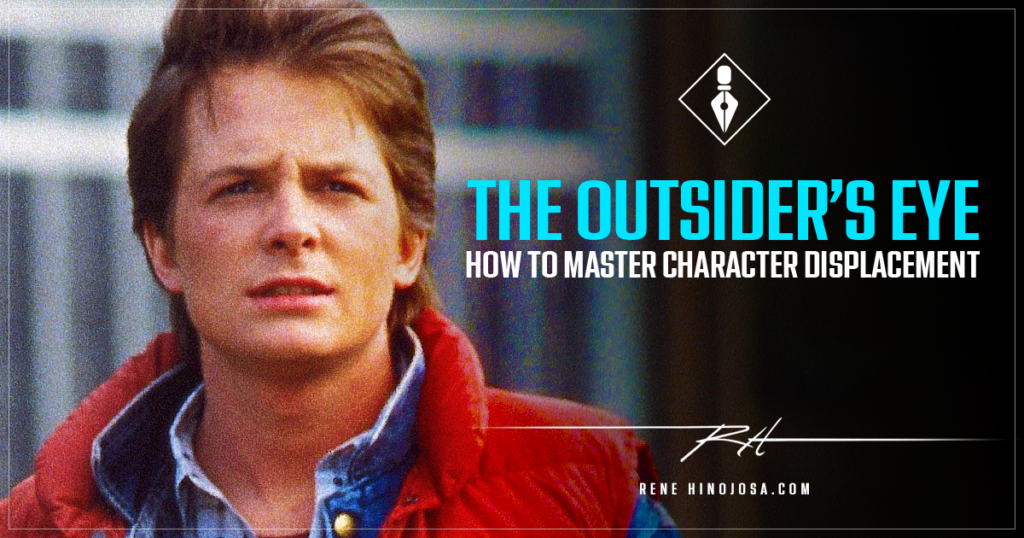
Marty McFly’s primary obstacle in Back to the Future is not just his unfamiliar mid-century surroundings. His route back to 1985 is severed by a hard resource barrier. The DeLorean time machine lacks plutonium, a substance unavailable in the 1950s. The barrier is not a locked door; it is a strict limitation of time, technology, and physics.
This invisible barrier transforms the narrative from a casual time-travel adventure into a desperate race for survival. Marty cannot drive away from his problems. He must immerse himself in the mechanics of 1955 Hill Valley, navigate his parents’ social lives, and track a lightning bolt just to survive. This unyielding constraint drives the plot forward.
The Social Wall
Outsiders do not just stumble over physical walls; they crash into invisible cultural boundaries. You generate narrative tension by surrounding your displaced character with an insular subculture that operates on tight, implicit laws. When your protagonist accidentally violates an unspoken standard of etiquette or survival, you heighten their isolation while forcing the reader to deduce the true nature of your society.
Ellen Ripley in Aliens is a traumatized survivor dropped into the cocky, hyper-militarized subculture of the Colonial Marines. When she attempts to brief the squad on Xenomorph lethality, she hits a wall of institutional arrogance. The marines mock her warnings, rely on their high-tech guns, and treat the mission as a routine assignment, dismissing her hard-won survival wisdom.
This sharp cultural friction isolates Ripley within the group that should protect her. The clashing perspectives heighten the dread for the audience, who know how dangerous the threat is. When the military infrastructure inevitably collapses, Ripley’s position as an institutional outsider allows her to pivot creatively, using a mundane warehouse power loader to save the day.
Summing It Up
True character displacement acts as a crucible for authentic character development. By trapping a protagonist behind physical barriers and forcing them to navigate invisible social walls, you strip away their superficial armor. This loss of security forces them to adapt. They shift their internal perspective and discover reserves of resilience and resourcefulness that would have remained dormant in their old lives.
When you design your next project, stop treating world-building as passive background decoration. Throw an unqualified, vulnerable outsider into the deep end of your universe. Let the narrative momentum flow from their desperate scramble for solid ground. The depth of your world reveals itself through the friction it creates against your characters—so build a universe that forces them to evolve or fail.
Until next time,