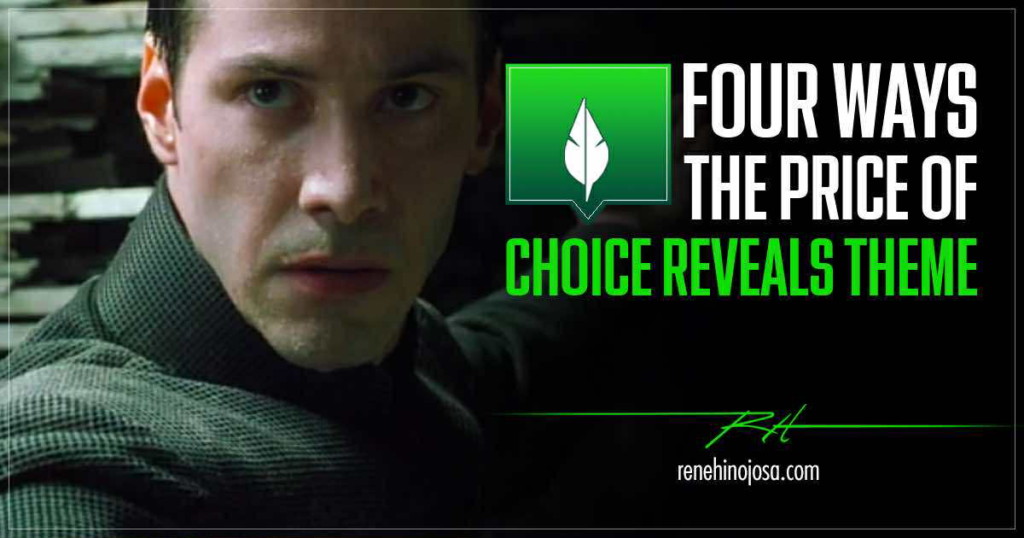
Last month, we examined the problem of choice and how it reveals theme. This is accomplished by introducing various thematic arguments to challenge your protagonist’s beliefs at each stage. But as their story nears its conclusion, your protagonist will realize the price of choice as they enter the endgame.
The Matrix Revolutions marks the culmination of Neo’s journey of self-discovery, ultimately leading him into unknown territory. It’s the moment where the principles of purpose, causality, and destiny finally intersect with free will. However, the choice to forge a new path comes at a cost, revealing profound themes. Let’s explore how the price of choice reveals these themes.
Four Ways The Price Of Choice Reveals Theme
The Price Of Choice Defined
The price of choice is directly connected to free will and its ability to bypass what was once defined as purpose, causality, or destiny. Until now, your protagonist has been constrained by existing thematic arguments of fate and predestination. Although they expect their journey to end in their desired outcome, they soon realize it leads to a paradoxical situation that leaves them in a no-win scenario, leaving the story’s resolution in limbo.
The questions your character asks focus on what’s true and what isn’t. But the answers they find will ultimately leave their fate and the fate of their world uncertain. The price of choice appears when they decide to bypass the paradox by risking everything to forge a new path toward the ideal resolution. The Matrix Revolutions explores this scenario, delving into profound themes of life, death, and rebirth.
Embrace The Endgame
Uncertainty will inevitably raise new questions that will lead your protagonist to evaluate their role and how their decisions have ultimately resulted in an endgame where their story’s resolution depends on their choice to embrace that end, no matter the cost.
After Neo is rescued from the Trainman by his friends, he immediately goes to the Oracle to confront her about the truth behind the prophecy. Although she has taken a new physical form as a result of her decision to help Neo and his friends, her answers stay cryptic. One thing is clear: Neo’s struggle to “know himself” is what has blocked his ability to figure out what to do in the face of the paradox before him.
Despite her ability to predict certain outcomes, the Oracle presents Neo with an uncertain endgame. Like him, she has made her own choices—choices she can’t see beyond to determine a definitive result. At the center of that uncertainty is Smith, who represents the chaos now threatening to destroy them all. The fate of everyone depends on Neo’s ability to face the endgame before him with the intent of reaching the desired resolution—no matter the cost.
Embracing The Unknown
While the unknown may have been a hindrance to them in the past, preventing them from deciding which path to take, your protagonist must now be willing to embrace the path toward resolution with their mysteries and unanswered questions.
While Smith remains the embodiment of chaos in Revolutions, he also introduces uncertainty, demonstrating his ability not only to corrupt the Matrix but also to infiltrate the real world. His entrapment of the Oracle is a tactic to absorb her power. And although she cannot see beyond her choice to sacrifice herself, The Oracle willingly embraces the unknown by submitting to his attack.
Likewise, Neo faces the unknown. Although his path was meant to end at the virtual source within the Matrix itself, his choice to save Trinity has created a new situation that ultimately forces him to chart a new course. Without the guidance of the Oracle or any other outside influence, he decides he must go to the heart of the physical machine city—a place that no one has dared to enter in over a hundred years.
The element of uncertainty is what drives these characters to move forward along their chosen paths, even without knowing the outcome. Since your audience is also unaware of what will happen, it encourages them to experience all the unpredictable factors to see how everything will eventually be resolved.
Embracing The Gamble
Making your protagonist question free will and predestination drives them toward an endgame where they will inevitably gamble on themselves, risking everything to find a way to resolve the conflict and benefit others more than themselves.
Discovering that Smith has invaded Bane’s body, Neo manages to defeat him but is left scarred and blinded by the fight. He still manages to infiltrate the machine city, but at the cost of Trinity’s life. Despite the sorrow and pain of all he’s lost, he awakens to new powers that allow him to see the machines in a different light—as luminous beings that thrive through a symbiotic relationship with humans. Knowing their existence will soon be threatened by Smith, their common enemy.
Until now, Neo’s path has been driven by a desire to end the war by destroying the machines. His new sight enables him to see the beauty in the existence of those machines. This leads him to no longer view them as the monsters he once thought they were. Instead, he realizes they are just as vulnerable to Smith as humans are. This new mindset enables him to see a way past everything he’s been told. By betting everything on his ability to eliminate Smith, Neo creates a new path that is mutually beneficial—one that could not only end the war but also forge a new reality where humans and machines can truly coexist.
Paying The Price
Your entire story has been building up to the question of whether your protagonist is willing to pay the price for their choice. By accepting that cost, they will inevitably resolve the conflict through a selfless act of sacrifice that serves the greater good.
Having brokered a deal with Deus Ex Machina, Neo is plugged into the Matrix and confronts Smith. But he soon learns that he and his enemy are evenly matched. Tired of the conflict, Smith spells out the inevitable: there is no way for Neo to win this fight. Frustrated and confused, Smith asks him why he persists. Neo’s response brings this saga of choice to its climax.
Neo and Smith embody the unstoppable force meeting an immovable object, creating the paradox that perpetuates their conflict. Neo slowly realizes that this paradox started when he destroyed Smith. It must now end with Smith destroying him. The Oracle predicted long ago that either he or Morpheus would die, and that the choice would be his. Neo finally accepts the price of his decision. He embraces his end, knowing it will break the paradox, balance the equation, and bring about Smith’s demise.
By sacrificing himself, Neo removes Smith from the Matrix, enabling the system to be rebooted and reset. In the epilogue, we learn that the Oracle herself had gambled everything on Neo. She believed that he could usher in a new era in which machine and man could coexist. She didn’t know if he would be able to fulfill that role, but she believed he would.
The price of choice is beautifully demonstrated here as an extension of free will over prophecy and predestination. It highlights how our lives are truly the sum of those choices.
Summing It Up
The price of choice and its connection to free will can create a profound resolution for your story. This enables you to explore thematic perspectives you may not have considered before. Knowing how to use this can help take your story in a fresh direction and bring it to a satisfying conclusion.
What are your thoughts on the Matrix Trilogy and its epic conclusion? How do you interpret the idea of choice and how it is used to bring about a strong resolution? How can you use these ideas in your own story? I’d love to hear your thoughts. In the meantime, keep looking for new creative ways to share your story’s themes. Let your creative light shine! And above all, keep writing!
Until next time,