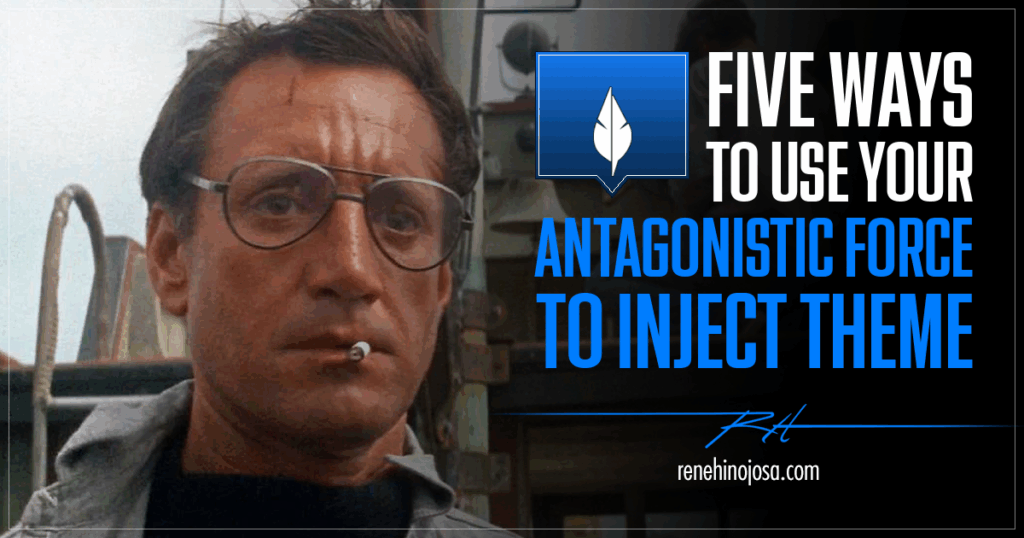
Besides your protagonist, your antagonist is probably the most important character in your story. Sometimes, that opposition exists as an unseen force that drives the main conflict, influencing every twist and turn. But how do you write a story that features an intangible enemy? And how do you use your antagonistic force into inject theme to your narrative?
Let’s use Jaws as a case study to better understand how an antagonistic force can drive the story’s action and connect directly to the theme.
Four Ways To Use Your Antagonistic Force To Inject Theme
- Reveal It Early
- Make It Relentless
- Incite Thematic Arguments
- Ramp Up The Fear
- Create An Explosive Climax
What Is An Antagonistic Force
An antagonistic force is essentially an elusive presence that serves as the main opposition in a story. Although it challenges the main character, it doesn’t exist as a person with reasoning or motivation. Instead, it manifests as a force of nature that threatens not only the protagonist but everyone in the story. This creates the central problem that pushes the protagonist to team up with supporting characters to find a solution. And it’s their interactions that ultimately inject theme to your narrative.
Jaws exemplifies this concept, focusing on an antagonistic force in the form of a killer shark—an animal that can’t be bargained or reasoned with. It simply exists to terrorize the people of Amity and its chief of police.
Reveal It Early
Begin by revealing the nature of the antagonistic force as soon as possible by creating a scene that shows what will happen if this chaotic entity is left unchecked. Display the destructive effects of its raw power to immediately set your story’s tone and stakes.
Jaws masterfully opens with a scene that shows us the primal force that exists beneath the waves. The scene is visceral and horrifying, immediately setting the tone for the narrative to follow.
The brilliance of this scene is that we never see the shark, and it’s that unseen, intangible aspect of this antagonistic force that makes it so terrifying. By introducing this problem early, the audience is deeply invested in finding out if a solution will appear.
Make It Relentless
Raise the intensity of each attack to swiftly push your protagonist and supporting characters out of their comfort zones. Use this to reveal their fears, weaknesses, and motivations as they face this force on both personal and community levels.
After learning that the young girl was attacked by a shark, Chief Martin Brody quickly moves to close the beaches. That decision is soon overturned by Mayor Larry Vaughn, who ultimately forces Brody to lift his order, leading to another brutal attack.
Jaws continuously builds tension by showing the relentless and unforgiving nature of its antagonistic force. The shark attacks again without mercy, claiming the life of young Alex Kitner and saddling Brody with guilt over his inability to stand up to Vaughn’s efforts to undermine him. With each incident, we see Brody’s fears, his weaknesses, and his mounting frustration with trying to do his job.
Incite Thematic Arguments
Create a diverse cast with different backgrounds, experiences, and motives to introduce multiple thematic arguments into your narrative. The use of multiple perspectives naturally elicits internal and external conflict among your characters.
The rogue shark plunges Amity into chaos. But instead of sparking compassion for those affected, it exposes the greed and selfishness of its residents as they squabble over how shutting down the beaches during the busy summer season will impact their businesses. It’s a situation that the eccentric Quint is all too happy to cash in on.
Hooper’s arrival affirms Brody’s growing concerns, but not even their combined efforts are able to convince Vaughn to shut down the beaches. Each spirited interaction continues to build tension into the story despite the shark not being physically present in the moment.
Thematically, these scenes are effective because everything revolves around the problem created by the shark. This naturally creates tension between each character, and that tension is what incites their thematic arguments.
Ramp Up The Fear
Use your antagonistic force to keep injecting the element of fear into your narrative, pushing your protagonist and supporting characters into action. Demonstrate their problem-solving skills and keep raising the stakes as you build toward the climax.
After his son nearly falls victim to the shark, Brody finally convinces Vaughn to approve hiring Quint to hunt down the shark. He and Hooper join the expedition, and it’s not long before they realize the enormity of what they’re truly facing.
Adding to the relentless nature of the narrative is the story’s ability to still inject fear into every scene, even when the shark isn’t visible or present like when Quint shares his story about how he survived the USS Indianapolis.
Thematically, it’s fear that unites these characters and ultimately fear that compels them to act. By building on that fear, you can push a story toward its inevitable climax.
Create An Explosive Climax
Build to a climax where your protagonist faces off against the antagonistic force in a deadly duel, thematically forcing them to confront their fear and become the immovable object that ultimately stops the unstoppable force.
With The Orca sinking, our heroes become desperate. Hooper is lost and Quint falls prey to the shark, leaving Brody alone to face this unstoppable predator on his own.
The tension slowly builds until Brody finally hits his target, turning the shark into fish bait. Brody’s victory means that the central problem is finally solved. Thematically, the hero has faced his fear and becomes stronger. It’s a triumphant moment, made even better by Brody reuniting with Hooper as they swim to shore.
Summing It Up
Knowing how to use your antagonistic force to inject theme into your story begins with understanding how that force propels your narrative. By leveraging it to establish the central problem of your story, you set the stage for your protagonist and supporting characters to work toward a solution. This thematically generates the tension needed to keep your audience engaged.
I hope this article has provided you with some insight into how to use your antagonistic force to inject theme into your story. What are some other powerful stories driven by an antagonistic force? How do they motivate you? I’d love to hear about them. Stay motivated, and most importantly, keep writing!
Until next time,